Home Interior Backgrounds for Covers: A Designer's Guide
Understanding the Visual Language of Interior Design Textures
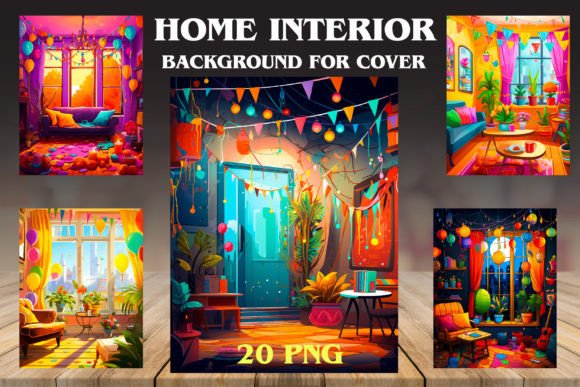
When you first look at the Home Interior Backgrounds for Covers collection, you aren't just seeing static images; you are seeing a toolkit for storytelling. This set of 20 high-quality designs is built around the concept of adult coloring book aesthetics, but its application goes far beyond simple relaxation activities. The visual characteristics here are defined by intricate linework, scalable vector precision, and a distinct lack of rigid structure. Unlike standard stock photography that locks you into a specific lighting condition, these backgrounds offer a modern typography feel applied to illustration—they are versatile canvases.
The personality of these assets is approachable yet sophisticated. They bridge the gap between the raw, hand-drawn energy of a handwritten font and the clean execution of professional design assets. You will find patterns ranging from soothing florals and complex mandalas to captivating geometric shapes. This variety is crucial for brand identity work. If a brand wants to convey mindfulness, organic growth, or creative chaos, these textures provide that emotional anchor without needing a single word of copy. The "white space" within these designs isn't empty; it is an invitation for the viewer to engage, making them powerful tools for visual hierarchy.
Strategic Applications: From Brand Identity to Commercial Products
For designers, entrepreneurs, and content creators, the value of Home Interior Backgrounds for Covers lies in their adaptability across different media. In editorial design, these backgrounds work exceptionally well for magazine covers, chapter headings, or full-page bleeds where you need to soften the transition between dense text and imagery. Because they are high-contrast line art, they pair beautifully with almost any typeface, from a bold sans serif font to an elegant serif font, allowing you to layer typography directly over the design without losing legibility.
In the realm of packaging design, these assets offer a tactile quality. Imagine a wellness brand, a tea company, or a boutique candle maker using these patterns on their boxes. The intricate details mimic the look of embossing or foil stamping at a fraction of the production cost. For social media graphics, these backgrounds are gold. Instagram stories, Pinterest pins, and LinkedIn banners often suffer from generic aesthetics. Using a mandala or a floral pattern as a subtle overlay or a bold background instantly elevates the post, making it look like custom creative font work rather than a template.
Furthermore, for those in the digital product space—such as selling planners, journals, or digital stickers on Etsy—these covers provide immediate perceived value. A digital planner featuring a unique Home Interior Backgrounds for Covers design feels premium. It signals to the buyer that the creator cares about aesthetics and user experience. It is a practical way to utilize design assets to stand out in a saturated market.
Technical Execution and Design Harmony
Using a decorative background effectively requires a solid understanding of visual weight. The Home Interior Backgrounds for Covers collection is dense with detail. If you pair a highly intricate floral background with a busy script font, the result will be visual noise. The professional approach is to create contrast. If the background is complex, your typography needs breathing room. Use a clean sans serif font with generous tracking, or a bold display font that can hold its own against the texture.
Consider the concept of font pairing extended to textures. Just as you wouldn't pair two competing typefaces, you shouldn't let the background compete with the message. A common mistake is treating these backgrounds as mere decoration. Instead, treat them as the "voice" of the design. For a project focused on relaxation or wellness, the organic curves of the florals act as a soft serif font, guiding the eye gently. For a project about structure or architecture, the geometric shapes act as a rigid grid, similar to a modern typography layout.
Color application is another key area. While the description mentions "adult coloring," as a designer, you should view these as grayscale maps. You can easily map specific colors to different line weights within the pattern to match a client's brand identity. This allows for infinite customization. You aren't buying 20 static images; you are buying 20 scalable systems that can be recolored to fit any season, campaign, or product line. This flexibility is what makes them a premium font equivalent in the world of illustration.
Practical Guidance for Implementation
When integrating Home Interior Backgrounds for Covers into your workflow, start by evaluating the project's medium. If you are designing for print—such as book covers or physical merchandise—ensure your color mode is set to CMYK. The high-contrast nature of these designs translates well to print, but you may need to adjust the line weight (stroke size) slightly if printing on uncoated, absorbent paper stocks to prevent the lines from bleeding together.
For web design and digital use, file size optimization is critical. While these are high-quality assets, loading a massive, unoptimized image as a website background will hurt your Core Web Vitals. Use modern formats like WebP or AVIF and apply lazy loading. In web design, these textures often work best as hero section backgrounds with a semi-transparent color overlay (like a brand color at 80% opacity). This ensures that white text placed over the background remains accessible and readable, adhering to WCAG contrast guidelines.
Finally, consider the licensing and usage. Since these are designed for commercial use, they are ideal for logo design elements (though you should modify them significantly to ensure uniqueness), merchandise, and client work. However, always verify the specific license terms regarding resale of the raw files. The goal is to use these design assets to create new, transformative works. By combining these intricate backgrounds with strong modern typography and a clear design strategy, you transform a simple coloring pattern into a professional-grade design solution.